
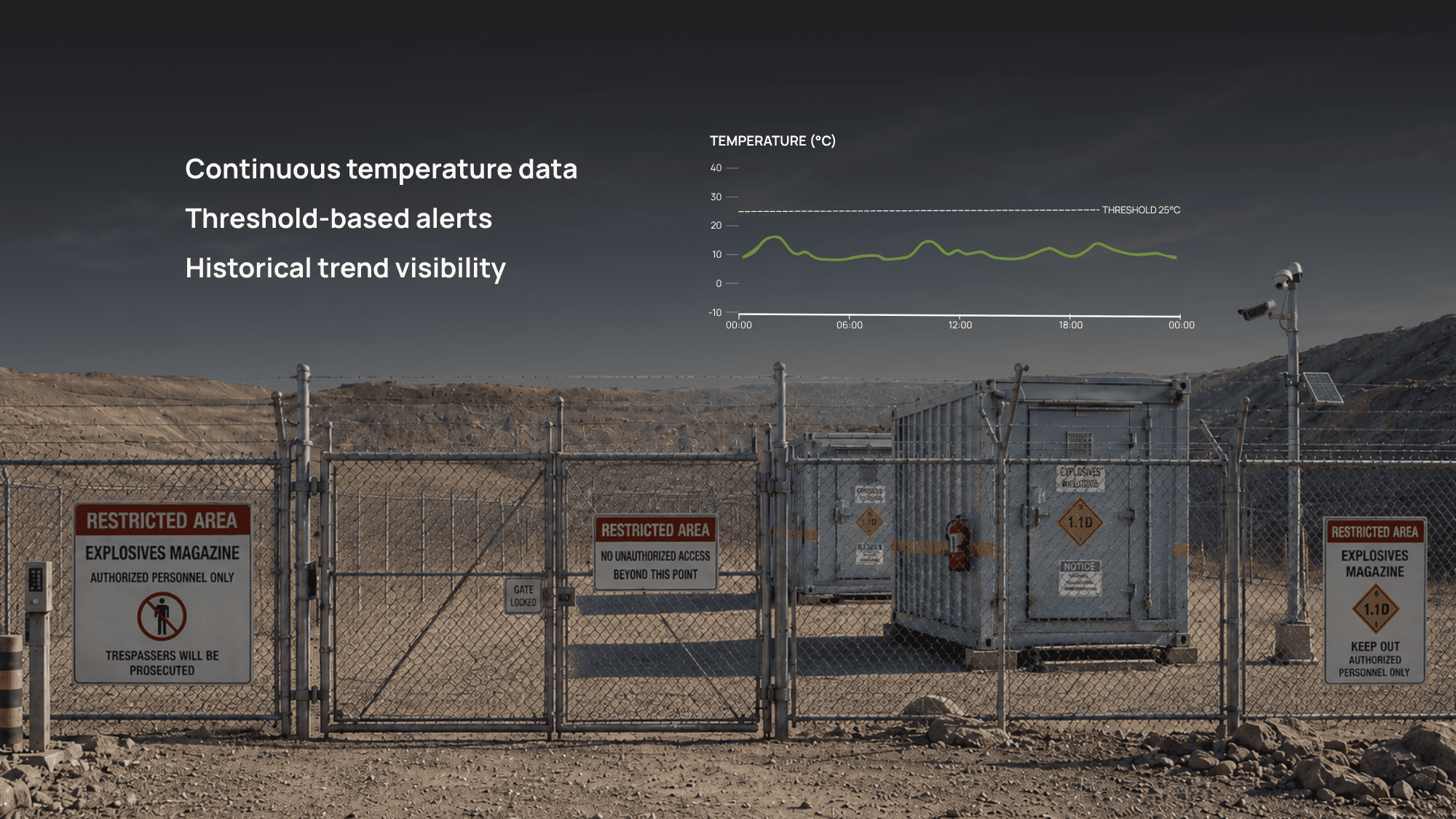
Temperature conditions in explosive storage areas are often confirmed through periodic manual checks, but that creates a visibility gap.
A reading taken once every few hours confirms the condition at that moment. It does not show what happened in the hours before the inspection, and it does not show what may start changing after the round is complete.
For explosive storage, this matters because temperature affects material stability continuously, not on an inspection schedule.
Why Temperature Stability Matters
Stored explosive materials, including emulsions and ANFO-based products, can be affected by temperature variation.
Elevated temperature may accelerate decomposition or contribute to material instability. In many cases, the concern is not a sudden event. It is a gradual thermal shift that may or may not be captured during the next scheduled check.
Low temperature creates a different operational problem. It can affect viscosity, crystallization, and handling behaviour once the material reaches loading, blending, or downstream use.
Both directions matter, but the real issue is the monitoring interval. A temperature deviation can develop between inspection rounds, where no continuous measurement is being captured. By the time the next manual reading is taken, the condition may already have changed significantly.
The Limits of Periodic Checks
Manual inspections remain important. They support site discipline, safety procedures, and regulatory routines.
But a manual check is still a single measurement at a single point in time. It does not provide a continuous trend. It does not show when a deviation started. It does not confirm whether the condition is stable, worsening, or returning to normal.
For remote magazines, distributed storage containers, and industrial sites with limited access, the gap between readings is often shaped by shift patterns, travel distance, weather, site permissions, and personnel availability.
That makes delayed detection a structural issue, not an execution problem.
Increasing the inspection frequency can help, but it does not remove the gap. It usually adds more site visits, more personnel hours, and more exposure for the people carrying out the checks.
Continuous Monitoring at the Storage Point

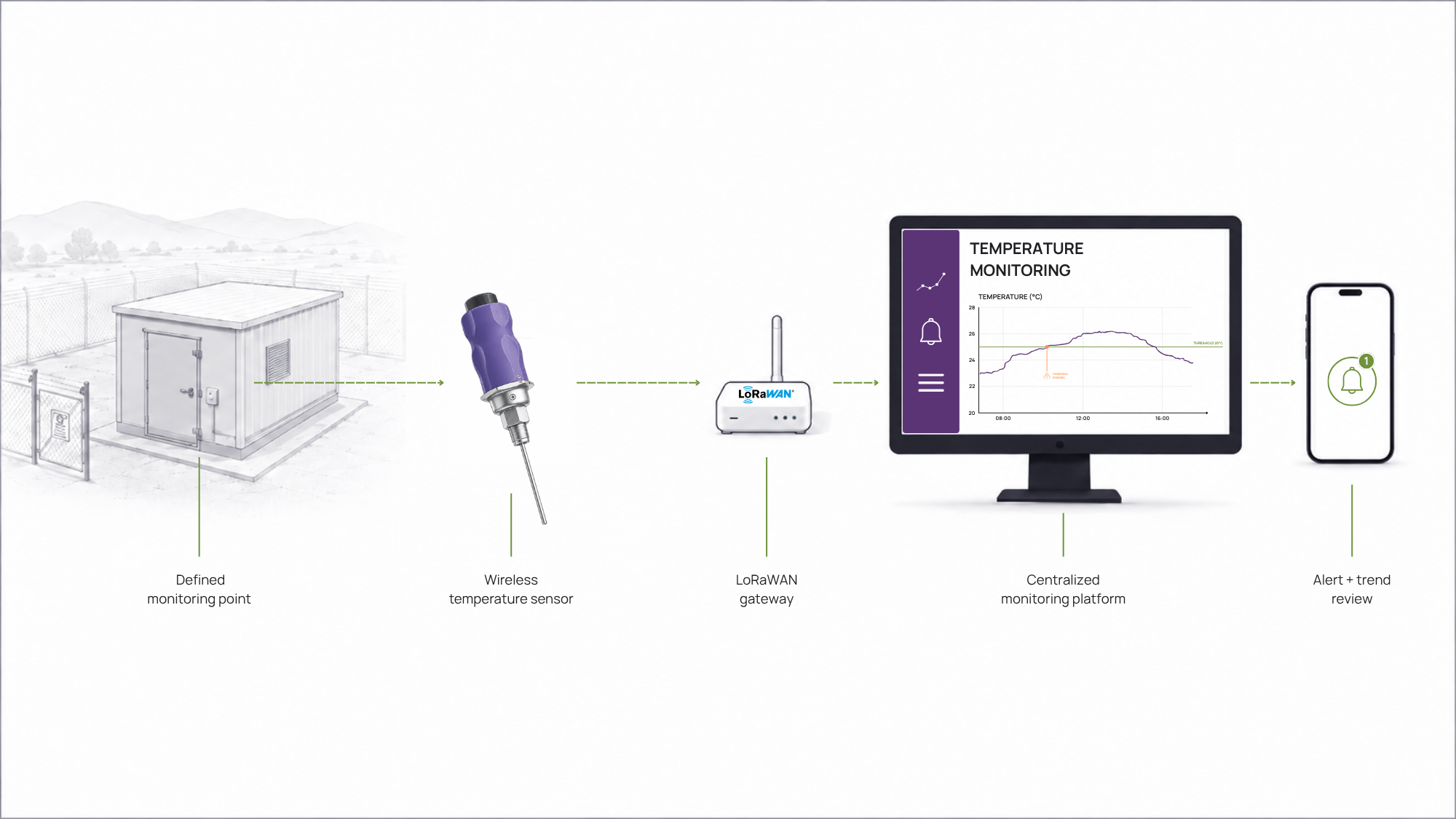
Wireless temperature monitoring adds a continuous data layer directly at the storage point.
SENSAiO Wireless Temperature Sensors can be deployed at defined monitoring points across explosive storage areas, including storage containers, warehouses, magazines, and related storage infrastructure. The exact mounting method depends on whether the application requires ambient, surface, or process temperature measurement.
Instead of relying only on logged readings from inspection rounds, teams receive continuous temperature data through a centralized platform. The system tracks trends over time, stores historical data for review, and generates threshold-based alerts when conditions move outside defined limits.
This changes the timing of detection. With manual checks, detection depends on when the next inspection takes place. With continuous monitoring, detection is tied to when the deviation begins. That is the specific gap a manual-check model cannot fully close, regardless of how disciplined the inspection schedule is.
Built for Industrial Storage Environments
Explosive storage areas require equipment selection to be handled carefully.
SENSAiO temperature sensors for hazardous-area deployments carry IECEx Zone 0 certification, Ex II 2 G Ex ia IIC T4 Gb which suitable for the most demanding explosive atmosphere classifications. Exact zone suitability, installation requirements, and site-specific compliance obligations should still be verified against current product documentation before deployment.
Battery life can reach up to 10 years at 15-minute reporting intervals, depending on signal strength, reporting configuration, and environmental conditions. This can help reduce the frequency of battery-related interventions in hazardous areas.
Data is transmitted over LoRaWAN to a centralized monitoring platform. Depending on the site architecture, data can also be integrated into existing operational systems through supported interfaces such as MQTT or REST API.
This makes the system suitable for retrofit monitoring applications where teams need additional visibility without redesigning the full storage infrastructure.
Monitoring, Not Control
SENSAiO provides monitoring. It does not control temperature. It does not replace ventilation, storage procedures, safety systems, explosive handling standards, or regulatory requirements.
Its role is to surface abnormal temperature deviations earlier, retain historical data, and give operations, maintenance, OT, and HSE teams better visibility into the condition of critical storage points.
The people responsible for explosive storage do not change. What changes is how early they know something needs attention.
Read the Use Case
Explore how SENSAiO supports explosive storage temperature monitoring with wireless sensors, centralized visibility, historical data, and threshold-based alerts.
Trusted by a Worldwide Network
With partners in over 20 countries, SENSAiO delivers rugged sensor solutions to the toughest environments — everywhere.


